
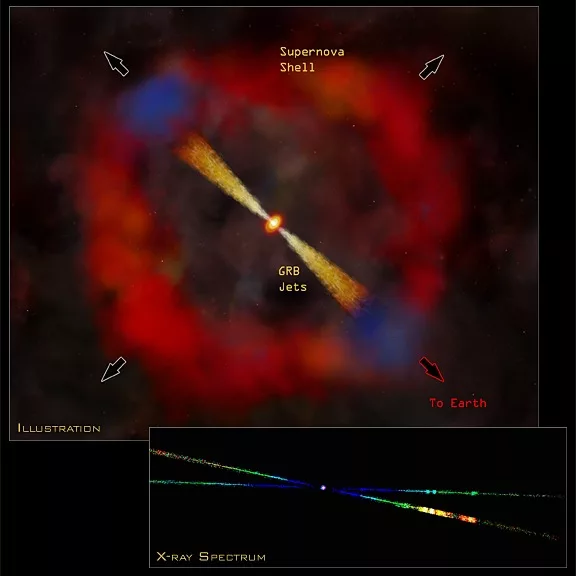
Chandra’s observation of the X-ray afterglow from this gamma-ray burst revealed an overabundance of silicon and sulfur ions thought to be present in an expanding shell of gas ejected by a supernova explosion of a massive star. The data support the supra-nova model for a gamma-ray burst, in which the burst occurs soon after, but not simultaneously with the supernova. Matter swirling near a black hole formed in the explosion produces a jet of high-energy particles and radiation that interact with the shell of gas to create the X-ray afterglow (see illustration). In the X-ray image below the illustration, the crossed bands are instrumental artifacts (not an image of a jet) of two grating spectrometers which have dispersed the X-ray light from the source.