
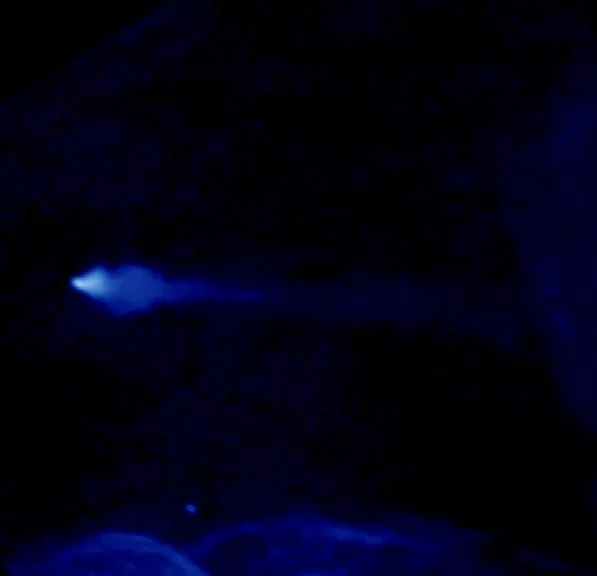
This image, a composite X-ray (gold) and radio (blue), shows a close-up of the head of the Mouse where a shock wave has formed as a young pulsar plows through interstellar space. Pulsars are rapidly spinning, highly magnetized, neutron stars left behind after the explosion of a massive star. Winds of high-energy particles from pulsars create large, magnetized clouds of high-energy particles called pulsar wind nebulas. In the case of the Mouse, the pulsar-wind nebula is swept back by the rapidly moving pulsar’s interaction with the interstellar gas. Near the front of the nebula an intense X-ray source marks the location of the pulsar, estimated to be moving through space at about 1.3 million miles per hour.